Agentic AI, Blue Collar, and New Competencies
The World Economic Forum (WEF) 2026 meetings have concluded, leaving behind crucial data for the global economy and the business world. The question “Will AI take our jobs?”, which was frequently asked in previous years, seems to have given way to more solution-oriented and pragmatic approaches this year. An analysis of the discussions at the summit and the published reports reveals four main trends emerging regarding the future of work.
Here are the critical headlines reflected from the Davos 2026 agenda to the business world:
1. The Prompt Era Ends, Agent Management Begins
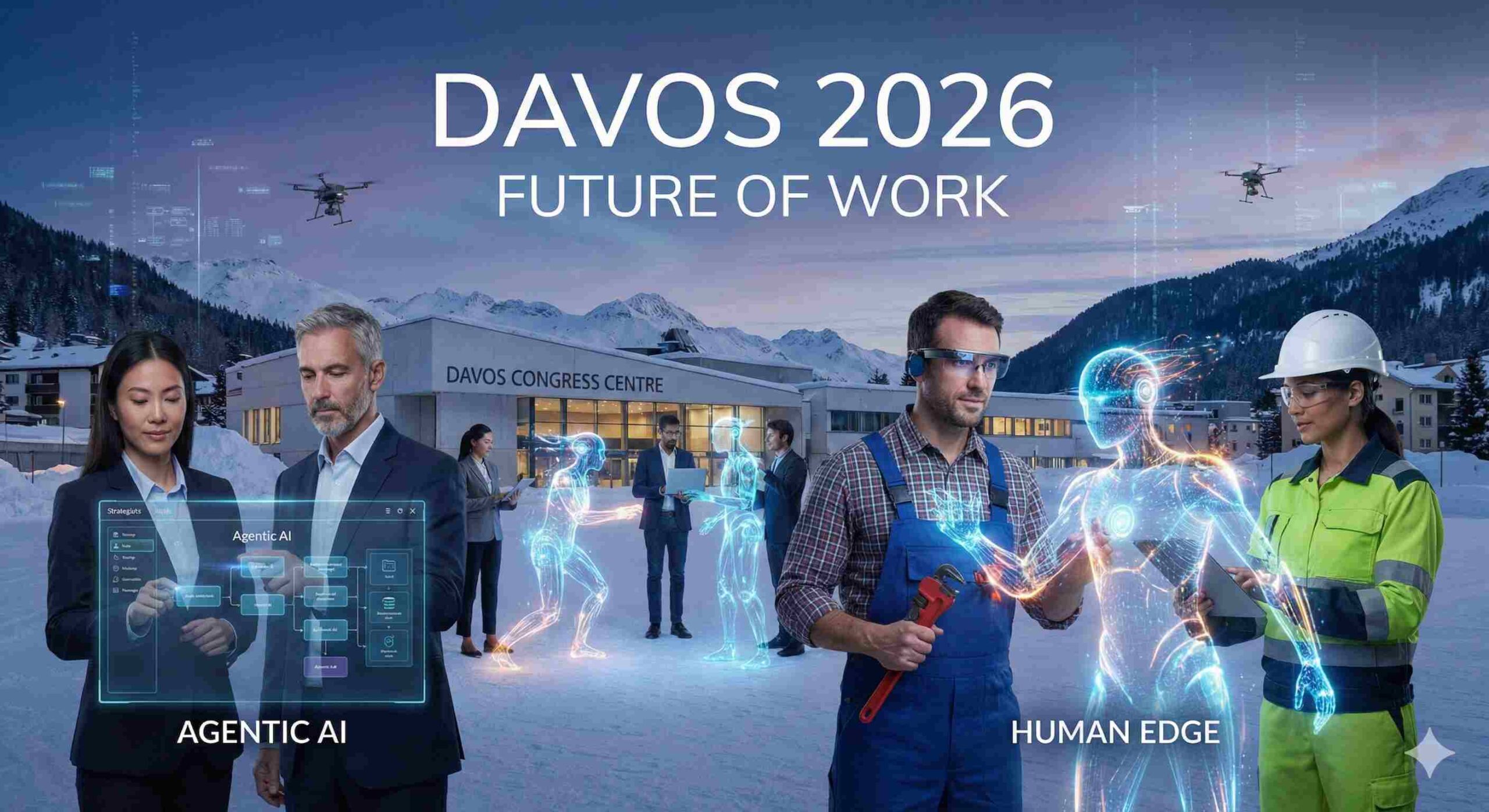
While “Generative AI” was the popular topic of the 2023-2025 period, the concept of “Agentic AI” takes center stage in the 2026 agenda.
This new approach signifies the evolution of AI from a tool that merely produces content upon command to a system capable of managing processes autonomously. In the old model, a user would ask AI for an email draft; in the “agentic” model, the request is to manage the entire campaign process. This shift is expected to accelerate the automation of routine white-collar jobs (data entry, coordination, basic analysis) and give rise to new competency areas such as “AI Orchestration.” The focus is shifting from personally doing the work to supervising the AI systems that do it.
2. A New Era for Blue Collar
At a time when digitalization is accelerating, the revaluation of physical skills stands out as a remarkable trend. Statements from technology leaders and various analyses indicate that professions requiring complex motor skills (skilled blue-collar) are areas that AI has not yet been able to fully simulate.
This situation is explained by “Moravec’s Paradox,” which states that while high-level reasoning is easy for AI, low-level sensorimotor skills are difficult. It is noted that the economic value of jobs requiring physical contact, such as electrical work, plumbing, and precision maintenance could increase, and that hybrid models combining technology with craftsmanship (e.g., drone-assisted agriculture or technological maintenance expertise) could become the safe harbors of the future.
3. Green Skills: No Longer a Preference but a Necessity
The climate crisis and sustainability issues are evolving from a niche area into a business necessity concerning all departments. New regulations bring about a requirement for “green literacy” in every field, from finance to marketing.
Data shows that the supply of the workforce with sustainability competencies lags behind demand, creating a significant talent gap. It is now becoming a fundamental expectation for a supply chain expert to understand the circular economy, or for a finance professional to be knowledgeable about carbon markets.
4. The Human Factor: Trust and Ethics
As automation increases, the importance of the human factor is being redefined around the axis of “trust, ethics, and emotional intelligence.” Within the framework of the “Human-in-the-loop” concept frequently emphasized at the summit, critical thinking, ethical reasoning, and complex negotiation skills are positioned as complementary elements to AI.
Collaboration Rather Than Competition
When the takeaways of Davos 2026 are summarized, it appears that a search for a new model of collaboration is underway, rather than a race against machines. In career planning, the needle is shifting towards deepening expertise in strategic and human areas where robots cannot compete.
Future projections indicate that standard and “average” tasks will be delegated to AI, while humans will create value primarily at two ends of the spectrum:
High-Level Strategy: Those who set the vision, build systems, and make ethical decisions.
Physical and Human Contact: Those who touch, repair, empathize, and exist in physical reality.
In summary, the new era seems to belong neither to those who reject technology nor to those who surrender to it completely, but to those who can blend AI literacy with human depth.
References:
1. World Economic Forum (WEF) Resources Official outcomes and reports of the Davos Summit are published here.
2. Human Resources and Talent Trends The series upon which the “Blue Collar” and “Talent Shortage” data in the article are based.
– ManpowerGroup Talent Shortage Reports
– Deloitte Global Human Capital Trends
3. Artificial Intelligence and Technology Vision Official blogs where “Agentic AI” and technology forecasts are shared.